Entity-Relationship Model
An entity–relationship model (ER model) is a Data Model for describing a Database in an abstract way at a conceptual level.
A database can be modeled as
- a collection of entities plus
- the relationships between the entities
Definitions
Entity is an object that exists and is distinguishable from other objects
- e.g. a company, an event, a person
- entities have attributes
An entity set is a set of entities of the same type that share the same properties
- set of all people, companies, events
A relationship is an association between several entities
- for example “student” entity – advisor (relationship) – “instructor” entity
A relationship set is a set of relations between two specific entities
- e.g. (studentId, instructorId) $\in$ advisor
An entity is represented by a set of attributes
- an attribute is a descriptive property that all members of this entity set have
- e.g.
instructor=(ID, name, street, city, salary) course=(ID, title, credits)
Domain is a set of permitted values for each attribute
Types of attributes:
- simple or composite
- single-valued or multi-valued
- derived (computed from other values)
- e.g. age given the date of birth
- composite attributes consist of other attributes (that also in turn may be composite)
; Keys A super key of an entity set is a set of one or more attributes
- these attributes must uniquely identity each entity
A candidate key of an entity set is a minimal possible super key
- e.g. id of an instructor
- although there could be several candidate keys, one must be selected to be a primary key
Relationships primary keys
- The combination of primary keys for entities that participate in a relationship form a primary key for that relationship
- e.g. (s_id, i_id) is a superkey for advisor
E-R Diagrams
Basic Notation
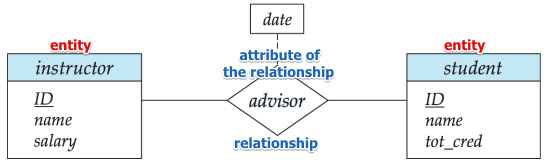
- rectangles represent entity sets
- attributes are listed inside
- primary key attributes are underlined
- diamonds represent relationship sets
- a relationship set may have attributes
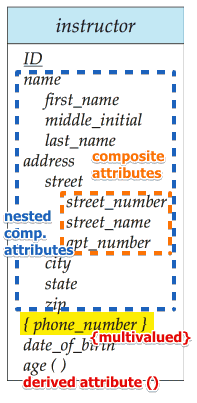
- complex attributes are shown with indent
{}is used to show multivalued attributes()shows that an attribute is derived
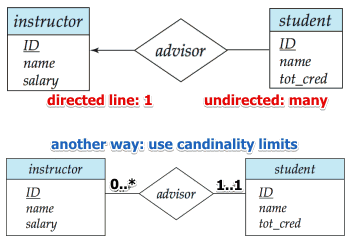
- directed line shows relationship with cardinality “one”
- undirected line - cardinality “many”
- alternatively, we can use cardinality limits
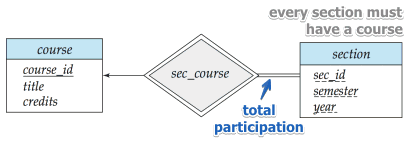
- this is called “total participation”
- indicated by a double line
- means: every entity set participates in at least one relationship
- opposite is “partial participation”
- some entities may not participate in any relationship
Weak Entity Sets
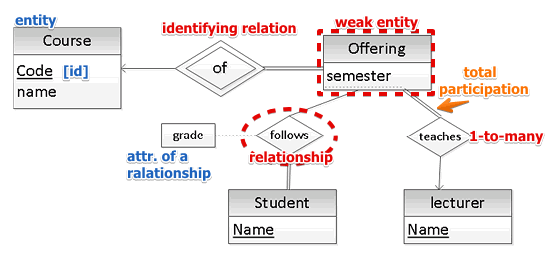
An entity set that does not have a primary key is a weak entity set
- the existence of a weak entity set depends of identifying entity set
- it must relate to the identifying entity set via a total one-to-many relationship set
Discriminator (or partial key) of a weak entity set
- this is the set of attributes that distinguishes an entity among another entities
So the primary key of such entities is formed by:
- the primary key of the strong entity (on which the weak one depends)
- the discriminator of the weak entity

- discriminator is underlined with a dashed line
- identifying relationship is shown with a double diamond
- in this case the primary key for section is (
course_id, sec_id, semester, year)
Note:
- the primary key of the strong entity set should not be stored explicitly with the weak entity set
- if
course_idwas stored in the weak entity, section then should be a strong entity - a weak entity cannot exist without an owner [stackoverflow.com/questions/4741967]
- example: a ROOM can only exist in a BUILDING
- a TIRE, on the other hand, can be a strong entity because it can exist without a car
- QUESTION is strong - it always exists, but ANSWER is weak - there have to be a QUESTION for an ANSWER
Example:
Reduction to Relational Schema
Entity sets and relationship sets can be expressed as relational schemas
- attributes of each schema typically correspond to attributes of entities and relationships
Translation
- strong entity becomes a schema with the same attributes
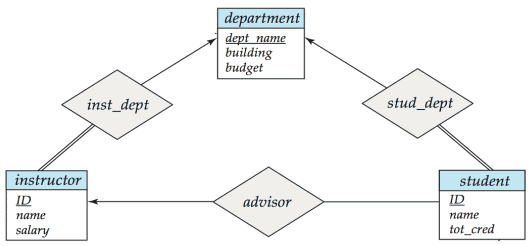
- student(ID, name, tot_credit)
- weak entity becomes a table that includes a column for the PK pf the identifying entity set
- section(course_id, sec_id, sem, year)
- a many-2-many relationship set is represented as a schema with
- attributes for all the primary keys of all participating entities +
- descriptive attributes of the relationship set
- many-2-one and one-2-many relationship sets can be represented by adding extra attribute to the “many” side
- instead of creating a schema for relationship set
inst_deptwe add an attributedept_nameto the schema for instructor - for one-to-one relationship any side can be chosen to act as the “many” side
- that is, an extra attribute is added to either side of the schema
- if participation is partial on the “many” side
- extra attributes may point to
NULLvalues
- extra attributes may point to
Exercises
Exercise 1
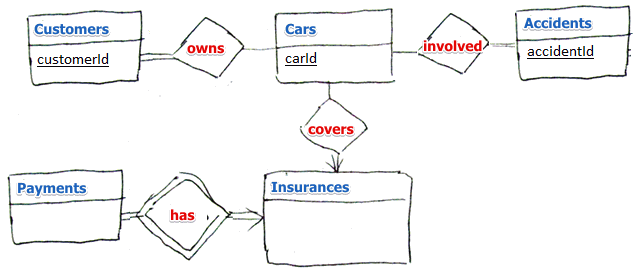
Car insurance company
- each customer has one or more cars
- each car is associated with zero or more accidents
- each insurance policy covers one or more cars and has one or more premium payments associated with a car
- each payment is for particular period of time and has a due date and the date when payment is received
Sources
- Database Systems Concept, slides for chapter 7 link: Most of the figures are taken from there
- Data Warehousing (ULB)