Voting Theory
Voting Theory studies how to take individual rankings of voters and aggregate them to form the global ranking.
Examples:
- Votes for a president of a company/country, etc. All voters communicate their results and based on that the president is chosen
- Search engines: there are many results, how to show them?
Notation and Relations
- let $A = {a, b, c, …}$ be the set of candidates
- there are $N$ voters
- each voter can express his preference on the basis of a total order
- i.e. he has to rank all the candidates
For this notation we define the following relations (Voting Theory Relations)
- Weak and Strong Preference
- Indifference
Voting Mechanisms and Principles
A voting mechanism (or voting procedure or voting method) takes a collection of votes (individual preferences of the candidates from set $A$) and forms the global ranking. Usually it choses a single candidate from the set $A$.
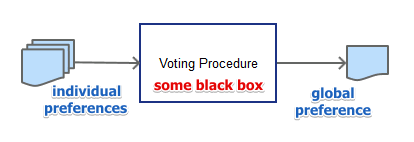
There are several voting procedures:
Criteria
How to characterize “good” voting methods?
There are several criteria
- Monotonicity
- Independence to Third Alternatives
- Condorcet Fairness Criterion
- Solution Existence
- Separability
| PV | 2PV | Borda | Cond. | Monotonicity | Yes | No | Yes | No | Solution Existence | Yes | Yes | Yes | No | Manipulation | No | No | No | No | Separability | Yes | No | Yes | Yes | Condorcet Fairness | No | No | No | Yes |
Other principles:
Theorems
Examples and Exercises
Misc.
- Banzhaf Power Index - shows how strong a party is
- Parliamentary Allocation - how to allocate seats between parties in a parliament
Links
- Mathematics of Voting - slides link
- Criteria link
- EC228 Voting Theory Lecture Notes link
- Social Choice Theory and Multicriteria Decision Aiding link
- Book: Voting, Arbitration, and Fair Division link
- Methods vs Voting Criteria link
Sources
- Decision Engineering (ULB)
- The mathematics of voting and elections: Paradox, deception, and chaos link